
I’ve never been crazy about the mass produced “art” that’s cranked out for the purpose of matching your sofa. Though sometimes colorful and pleasant in its own limited way, at its heart, it’s banal and expressionless. It communicates nothing. And what a shame that so many of us settle for this kind of visual poverty in our homes. By doing so, we choose to forgo the enrichment that more meaningful art can provide for us.
But at the same time, I’m not of the opinion — so prevalent in today’s art world — that if works are “pretty” in the obvious sense of the word, they are automatically less important or are socially irrelevant. That is, quite simply, bunk.
A quick journey through art history reveals that each new movement has been, in large part, a reaction to the one before. Works are products of their time, and many are tied inextricably to powerful sociopolitical changes and brilliantly reflect these. But even the less outspoken, more purely aesthetic pieces are never completely devoid of meaning or expression, because they are always filtered through an individual artist’s unique sensibilities and personal voice.
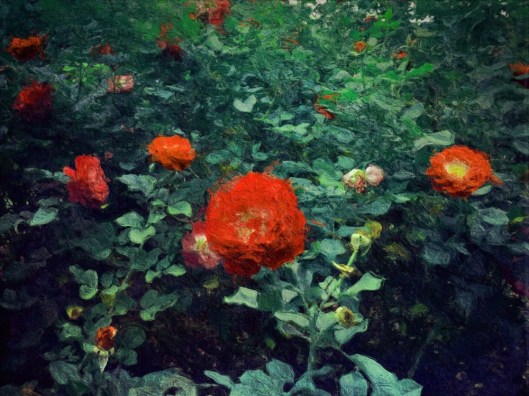
Illustration: Barbara Gowin
And while no period in art can or should be without its larger overriding intellectual philosophies, there’s no denying that certain pieces will always speak to us in a more simple and direct way, regardless of their period. What I’m talking about here is the sensuous pleasure of aesthetics simply for aesthetics’ sake. A gut response of … “Wow! That’s lovely.” This is something we all, universally, like to feel.
So perhaps it’s not surprising that our historical love of ornamentation, seen so often across cultures in earlier centuries, flourished for so long in both art and craft. It survived the scientifically savvy age of enlightenment and beyond, well into the twentieth century. There persisted a juxtaposition of the ornamental with the functional, as if we simply could not bear to relinquish its pleasing forms. We held onto decorative beauty just as long as we could before it was replaced by the inevitable form-follows-function approach that we take for granted today.


And while I appreciate the clear, strong lines of the mid twentieth-century aesthetic as much as the next boomer, I find I also miss the visual richness that it has systematically stripped away, so that mass-produced minimalism and efficiency are so often our goals today. But though this is an integral part of where we’ve come and who we are, we shouldn’t forget that there can always be more.
And what is more? Satisfying complexity. Exquisite color palettes. Voluptuous textures. Sensitive, vibrant rendering of natural forms. But also a kind of fourth dimension … one of emotion, inspiration and, sometimes, transportation to another place and time.
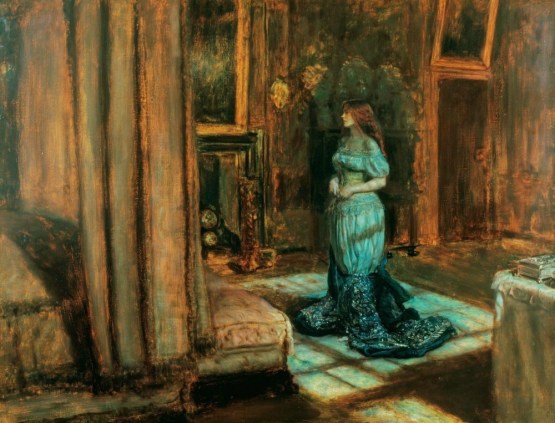
John Everett Millais – The Eve of St. Agnes Via: Wikimedia Commons

John Atkinson Grimshaw – At the Park Gate Via: Wikimedia Commons
Lately, my favorite travel guides are from the eighteenth and late nineteenth centuries. These artists lead me through fantastic landscapes, gardens, boudoirs and bowers. Golden Age illustrators fly me to fairy tales and fantasies. And all of them treat me to a remarkable world of beauty and imagination.

Arthur Rackham – Frog Prince Via: Wikimedia Commons

John Atkinson Grimshaw – The Lady of Shalott Via: Wikimedia Commons
It’s a world I’d never deeply explored because of my own personal bias against the pretty. I thought that pretty meant silly, superficial. Pretty meant unsophisticated. But now, I say we all need a break from the ugly, a little softness around life’s sharp contemporary edges.
And besides, art is a moveable feast … so why not dine sumptuously?
________
Following illustrations- Barbara Gowin:
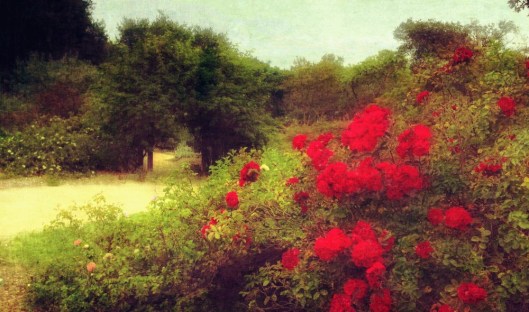
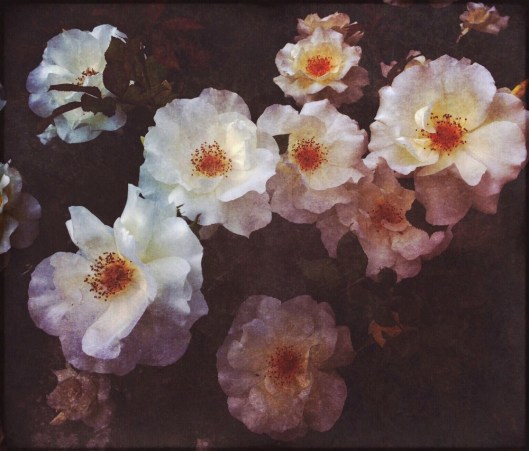

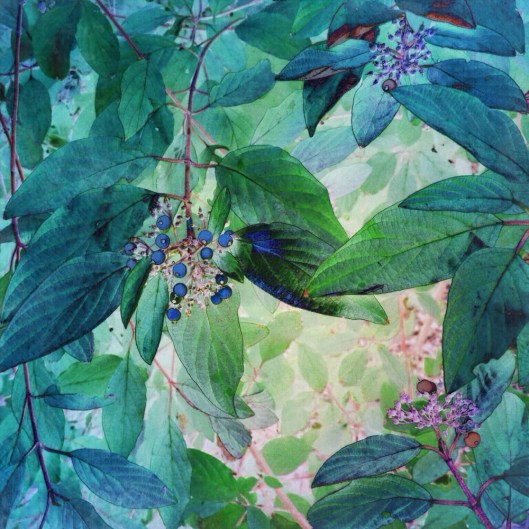


 Of Poems and Particles


